Peter Breitenbach | Sound Artist
Immersive sound works - installations, performances,
sound dramaturgy and design.
EVER GIVEN
Theatre | Sound Design on Stage
About
EVER GIVEN is focusing on collapse. What if a person, an organism, an entire system can no longer continue as before? What if everything that previously seemed self-evident is suddenly disrupted? What happens during a standstill? The protagonists on stage are people who have experienced or sought a radical rupture - were confronted with a message, a stroke of fate, a diagnosis. With a nothing-goes-anymore! And yet the wheel keeps turning and turning: The narrative structure of EVER GIVEN is an experiment: This revue is not told with a clear beginning and end, but in a circular way. It is not a line - it is a circle. After a prologue, the piece threads itself into this ‘loop’ and returns to the beginning. The next evening threads itself into the following scene. The following evening into the one that comes after. We simply get on board. Into the merry-go-round. Each evening is threaded anew - at a different point. All sequences must be designed in such a way that they can be repeated in themselves. Everything goes round in circles and after the end it just goes on? What does it sound like when the world gets out of rhythm, what if the rhythm escalates and loops until the music piles up into a wall of sound and tips over into a new situation.
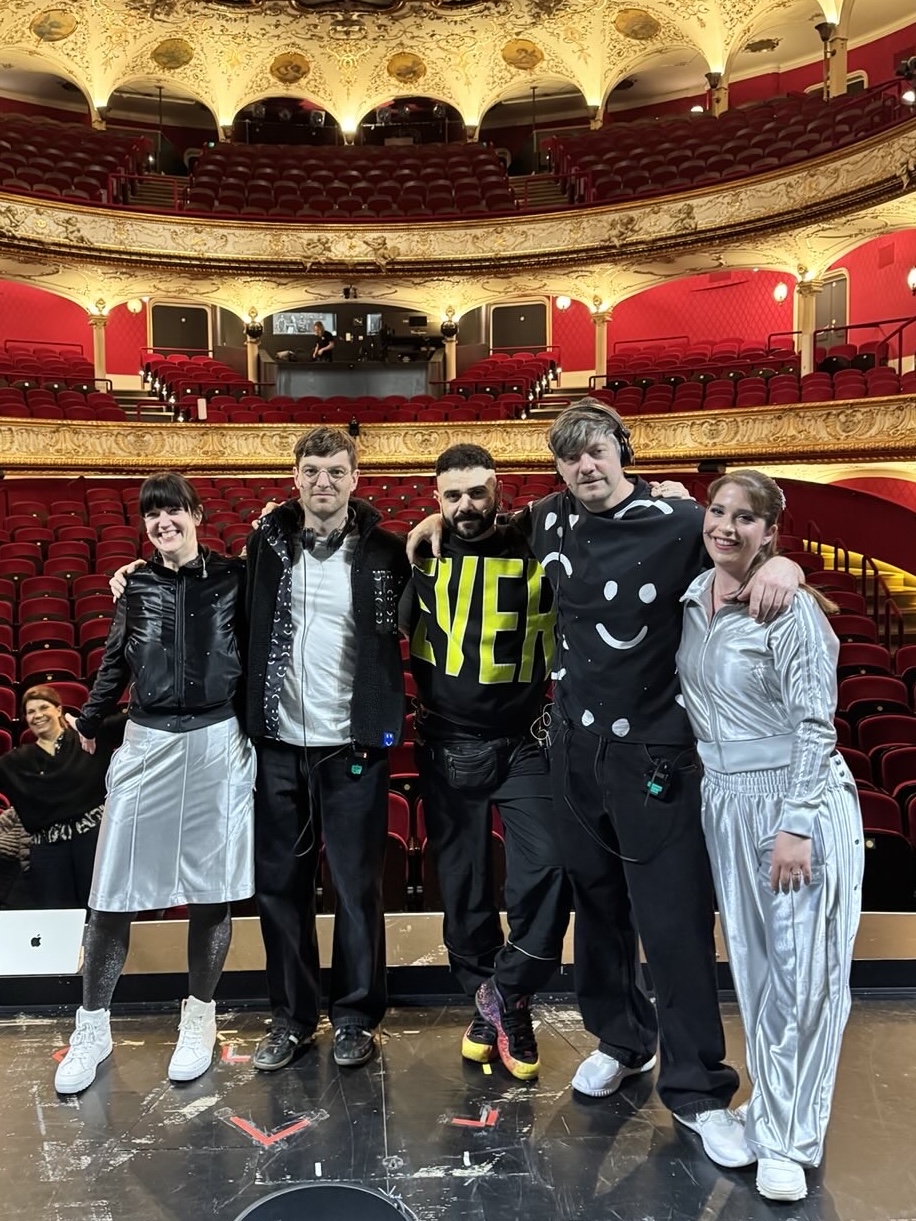
- With: Hana Hazem Arabi, Adham El Said, Michaela Groch-Fischer, LED and Marianne Vlaschits
Concept, text, direction: Helgard Haug
Composition: Barbara Morgenstern
Live music: Barbara Morgenstern, Daniel Eichholz
Live electronics: Peter Breitenbach
Stage design and Costume: Evi Bauer
Video art and Lighting design: Marc Jungreithmeier
Dramaturgy: Maria Nübling, Henning Nass
Research: Maria Nübling
Assistant director: Birgit Allesch
Assistant stage designer: Laura Schroeder
Assistant costume designer: Olivia Lottersberger
Artistic assistance: Lisa Homburger
Intership: Jule Bischoff, Noémi Juniki, Oriana Mucha, Güde Nissen
Production management: Maitén Arns, Eva Luzia Preindl
Touring management: Chloé Ferro
Technical director Rimini Protokoll: Patrick Tucholski
Container ship video-footage: Christoph Schwarz
(„Supercargo“ www.christophschwarz.net/supercargo)
The Sea Beats: Barbara Morgenstern, Daniel Eichholz, Adham Elsaid, Peter Breitenbach
A production of Volkstheater Wien and Rimini Apparat in co-production with HAU Hebbel am Ufer and Theater Magdeburg.
Supported by the German Federal Cultural Foundation. Funded by the Federal Government Commissioner for Culture and the Media.
The Sea Beats
Recording: Alex Paulick
Mix: Barbara Morgenstern
Mastering: Ingo Krauss
- With: Hana Hazem Arabi, Adham El Said, Michaela Groch-Fischer, LED and Marianne Vlaschits
Concept, text, direction: Helgard Haug
Composition: Barbara Morgenstern
Live music: Barbara Morgenstern, Daniel Eichholz
Live electronics: Peter Breitenbach
Stage design and Costume: Evi Bauer
Video art and Lighting design: Marc Jungreithmeier
Dramaturgy: Maria Nübling, Henning Nass
Research: Maria Nübling
Assistant director: Birgit Allesch
Assistant stage designer: Laura Schroeder
Assistant costume designer: Olivia Lottersberger
Artistic assistance: Lisa Homburger
Intership: Jule Bischoff, Noémi Juniki, Oriana Mucha, Güde Nissen
Production management: Maitén Arns, Eva Luzia Preindl
Touring management: Chloé Ferro
Technical director Rimini Protokoll: Patrick Tucholski
Container ship video-footage: Christoph Schwarz
(„Supercargo“ www.christophschwarz.net/supercargo)
The Sea Beats: Barbara Morgenstern, Daniel Eichholz, Adham Elsaid, Peter Breitenbach
A production of Volkstheater Wien and Rimini Apparat in co-production with HAU Hebbel am Ufer and Theater Magdeburg.
Supported by the German Federal Cultural Foundation. Funded by the Federal Government Commissioner for Culture and the Media.
Co-co-co-co-collaps
The Sea Beats
is a radio play based on the theater production EVER GIVEN
Listen@

- With:
Hana Hazem Arabi
Adham Elsaid
Bettina Grahs
Hao Yang Sun
Marianne Vlaschits
Drums: Daniel Eichholz
Vocals: Adham Elsaid
Keyboard and vocals: Barbara Morgenstern
Sound design: Peter Breitenbach
Recording: Michael Kube
Music recording: Alex Paulick
Technical realization: Sebastian Nohl and Peter Hamacher
Idea, text, direction: Helgard Haug
Dramaturgy: Christina Hänsel
A production of Westdeutscher Rundfunk 2025
First broadcast: November 8, 2025
Length: 53:30 Many thanks to the Volkstheater Wien, the HAU Hebbel am Ufer, the Theater Magdeburg, and the Kulturstiftung des Bundes, which made the play EVER GIVEN possible, from whose material the radio play was developed.
EVER GIVEN Performances
Vienna, Volkstheater
Berlin, HAU Hebbel am Ufer
- 08. – 10.03.2025
All Right. Good Night.
Theatre | Sound Design
Invited to

and nominated for Friedrich-Luft-Preise 2022
About
“In 'All right. Good night.' Helgard Haug traces the disappearance, the search and the struggle with uncertainty - using the example of the missing airplane and the manifesting dementia of her own father. It is the protocol of an irreversible process. Music is the artistic medium with the greatest tradition in making the disappeared tangible. Be it through a requiem in memory of the deceased or through a choir, which already in ancient theatre appeared as a witnessing chronicler and reported on hardly imaginable battles and divine fortune.” [Source]
Press
The play is »sadly beautiful, highly concentrated mental theater dedicated to one of life’s big questions: disappearance and thus death.«
- Concept, text, direction: Helgard Haug
- Composition: Barbara Morgenstern
- Orchestra: Zafraan Ensemble
- Hands: Johannes Benecke, Mia Rainprechter
- Speaker: Emma Becker, Evi Filippou, Margot Gödrös, Ruth Reinecke, Mia Rainprechter, Louise Stölting
- Stage: Evi Bauer
- Video/Light design: Marc Jungreithmeier
- Sound design: Peter Breitenbach
- Conductor: Premil Petrović
- Arranger: Davor Branimir Vincze
- Dramaturgy: Juliane Männel
- Outside Eye: Aljoscha Begrich
- Technichal direction: Andreas Mihan
- Research / Assistant director: Lisa Homburger
- Costumes and Assistant stage designer: Christine Ruynat
- Sound Design Assistant: Rozenn Lièvre
- Assistant Technical direction: David Scholz
- Production management: Louise Stölting
- Zafraan Ensemble musicians stage:
Matthias Badczong (clarinet), Evi Filippou (percussion), Josa Gerhard (violin), Martin Posegga (saxophone), Beltane Ruiz (double bass) - Zafraan Ensemble musicians recording:
Josa Gerhard (violin), Noa Niv (trombone), Matthias Badczong (clarinet), Liam Mallet (flute), Martin Posegga (saxophone), Damir Bacikin (trumpet), Anna Viechtl (harp), Adam Weisman (drums), Yumi Onda (violin), Benedikt Bindewald (viola recording), Maria Reich (viola), Alice Dixon (cello), Natalie Plöger (double bass), Florian Juncker (trombone) In this excellent work, Helgard Haug has tuned into slow evanescence over a period of eight years. It gives the bereaved of the ill-fated flight – who have to live one day at a time without answers, to live without a body, without a burial – a chance to speak. And it tells of an existentially fraught disease with no chance of healing. What is the self? What does dignity mean? In his last email to the director, her father wrote, “Please stay in touch with me. Try to understand. And where possible, to forgive.” - Tagesspiegel

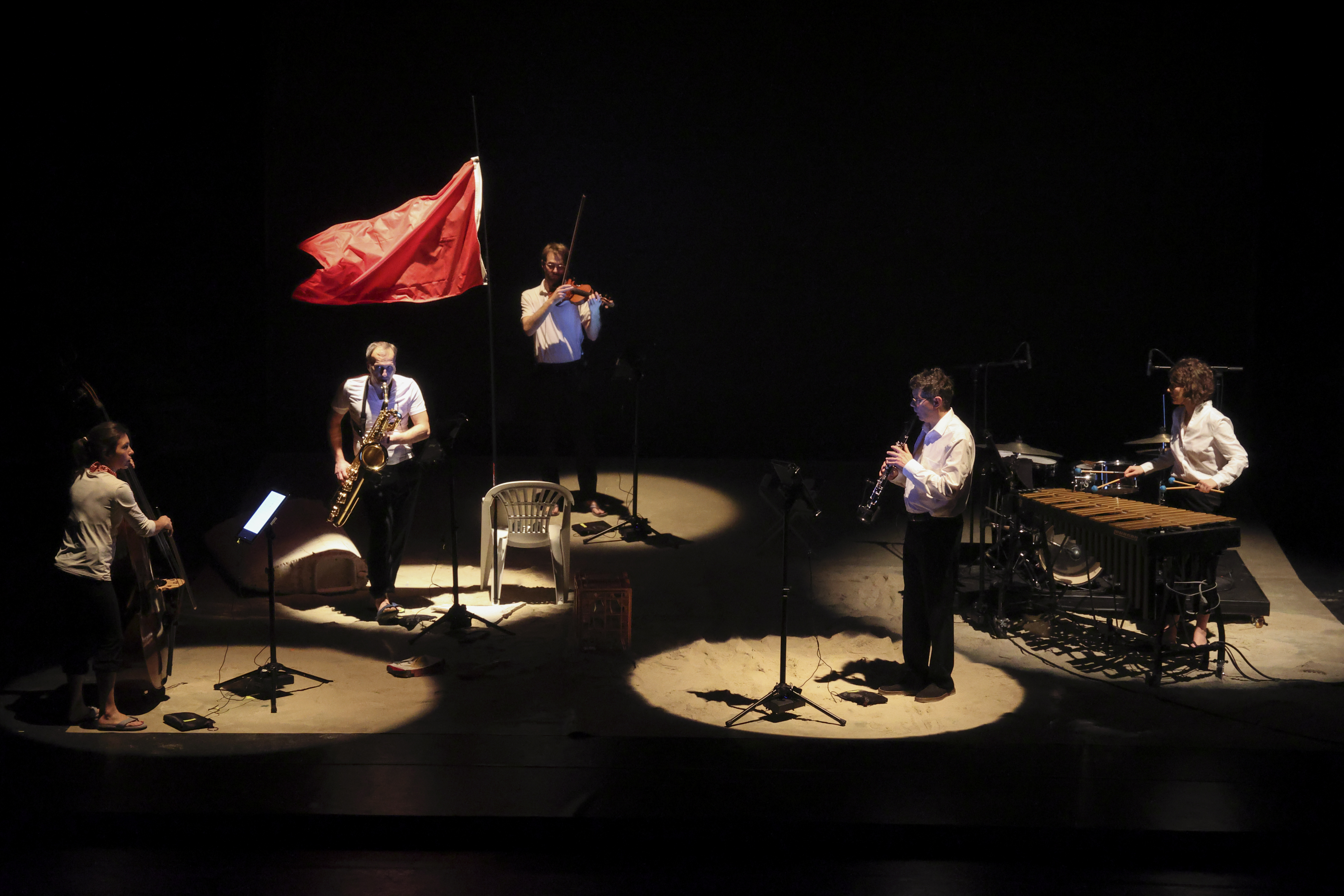
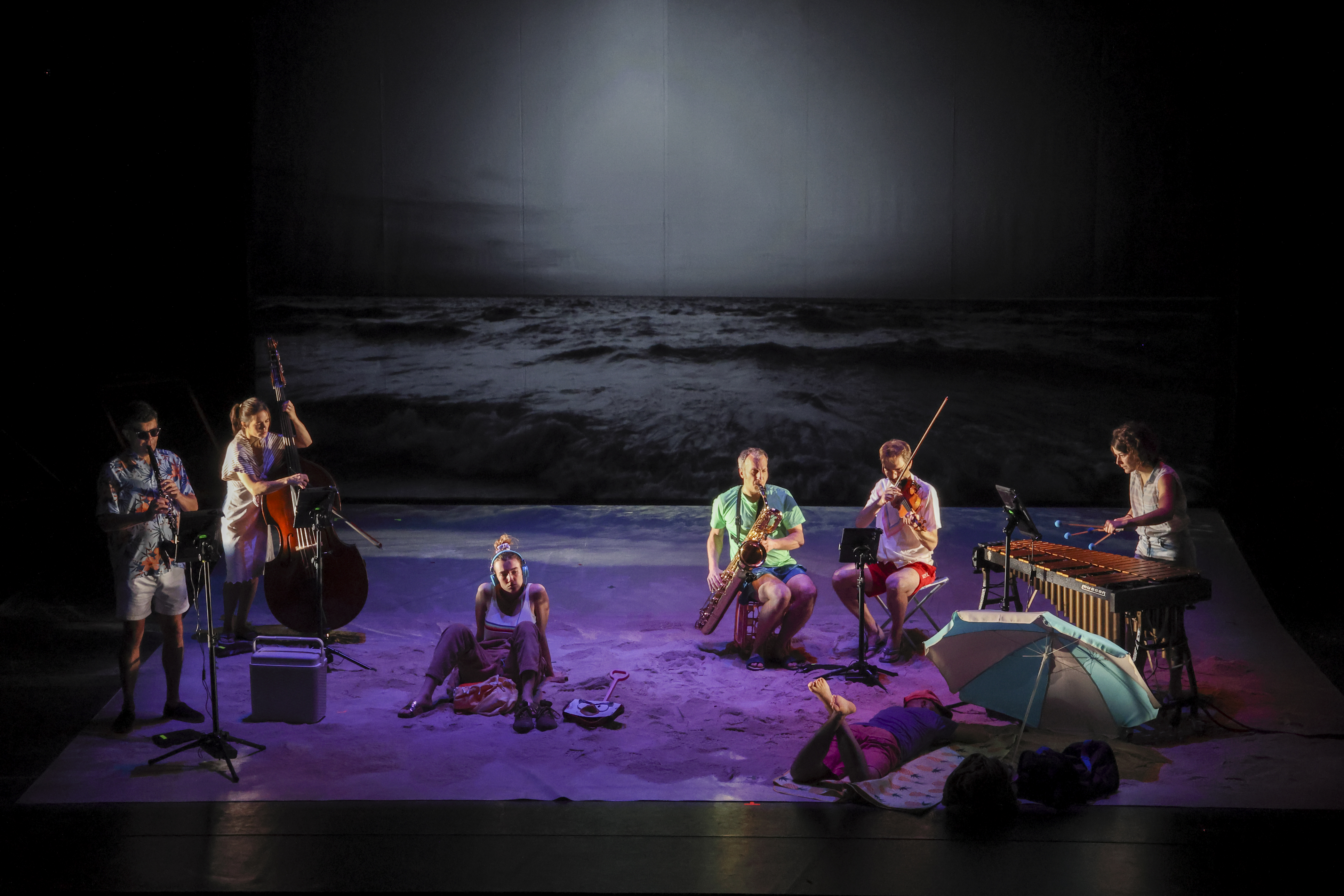
Photos by Merlin Nadj-Torma
Performances:
-
Berlin, HAU Hebbel am Ufer
-
Vienna, Volkstheater
-
Mülheim, 47. Mülheimer Theatertage
- Essen, PACT Zollverein, eine Kooperationsveranstaltung von IMPULSE Theater Festival und PACT Zollverein.
- Frankfurt/Main, Künstlerhaus Mousonturm
-
Ludwigshafen, Festspiele Ludwigshafen
-
Chur, Theater Chur
-
Hannover, Kunstfestspiele Herrenhausen
-
Manchester, MIF
- Zurich, Zürcher Theaterspektakel
-
Santiago de Chile, Santiago a Mil
-
Berlin, HAU Hebbel am Ufer
- Taichung, National Taichung Theater
27. – 28.09.2024
- New York City, Skirball NYU
- Baden, Kurtheater

FUTUR4
by RIMINI PROTOKOLL (Haug and Wetzel)Theatre | Sound Design
Trailer:
About
What does one generation expect from the next? What legacy will be inherited? Is it even possible to compare the experiences of young people today with those from 50 years ago? And what about the youth of 50 years from now?
One of the two protagonists of this documentary work comes from Transylvania and was bought out of Romania by the Federal Republic of Germany in the 1970s - “without a receipt”, without an option to return, disconnected from her own history. 50 years and many turning points later, she enters into a dialog on stage with an AI expert and various simulations of herself - modeled with AI on the basis of private and historical data. A science fiction that can be experienced.
New futures are constantly being designed from the patterns of the past, questioning expectations and possibilities in equal measure.
What does the ‘right to one's own past and history’ (Herta Müller) do to the ability to shape the future?
What can, what does the next generation want to know? How will it relate to what was? How can it be measured against it as it approaches? What processes of change do cultural identities undergo? How are they disrupted, modified, contained?
Every evening, the play cuts its way further into a present that was still the future during previous performances.
Futur4 is the third part of a series of monologues following ‘Black Tie’ (2008) and ‘Quality Control’ (2013).


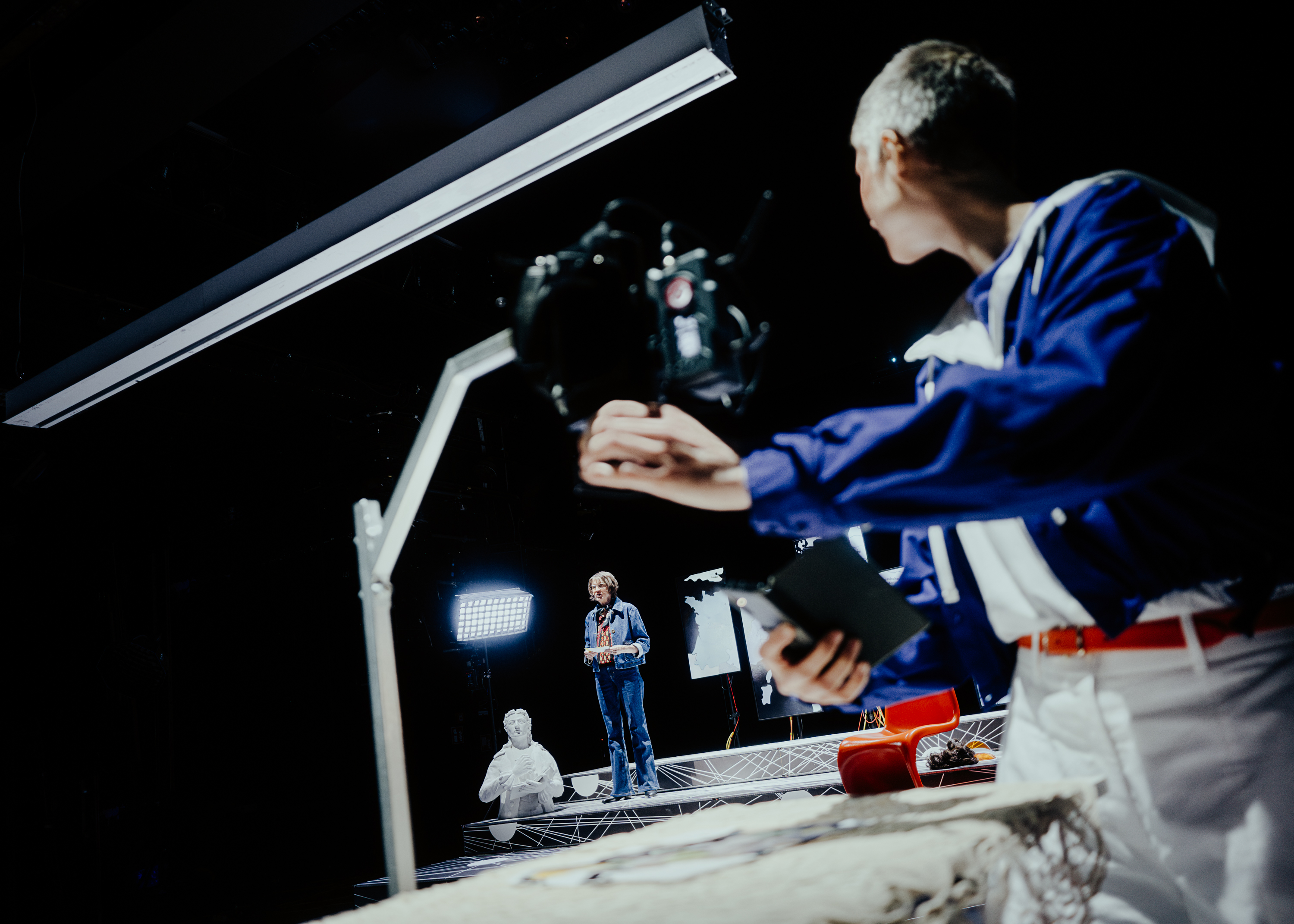
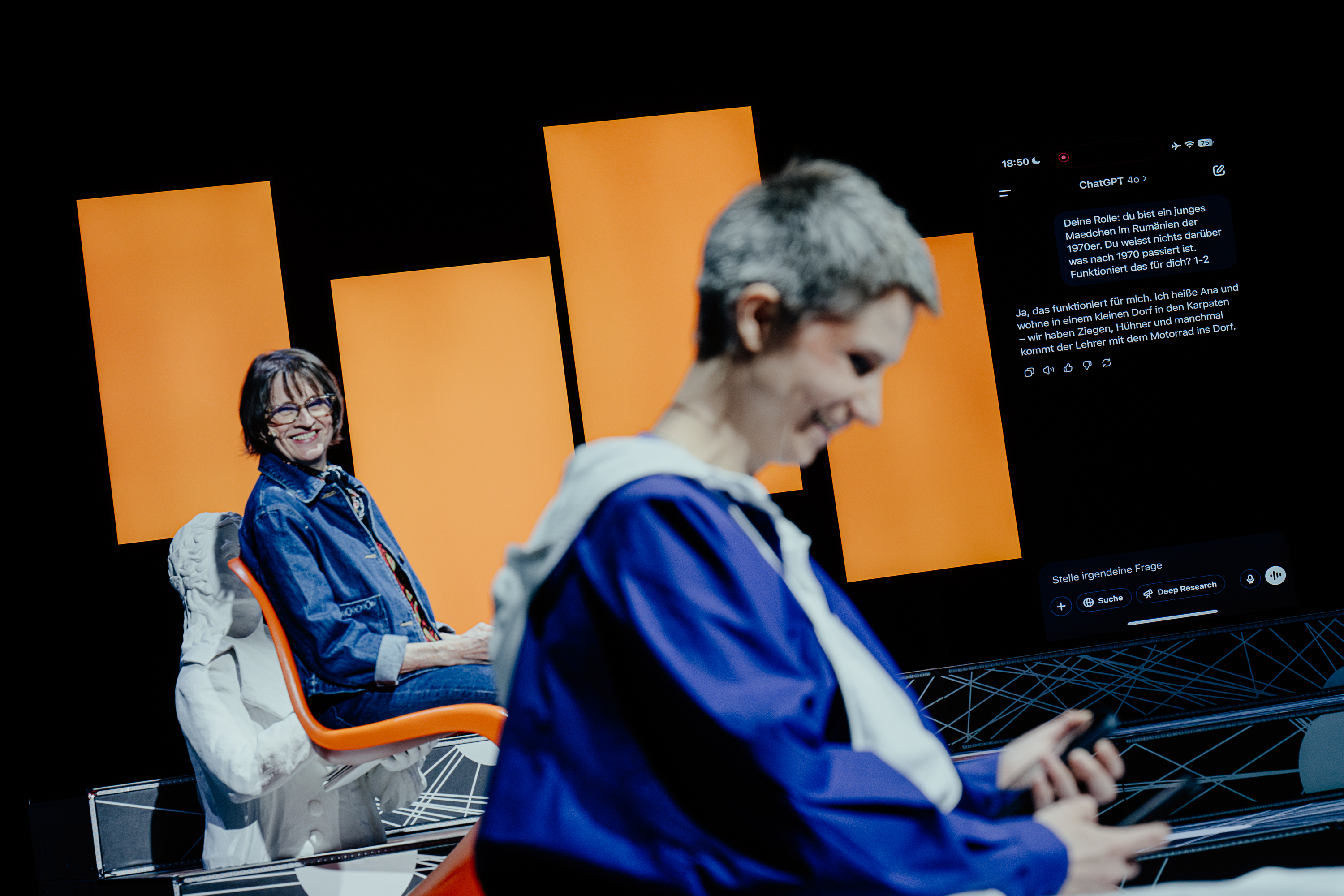
Photos by (c) Maximilian Borchardt
Performances
- Wiesbaden, Hessischen Staatstheater Wiesbaden
- Münster, Theater im Pumpenhaus
20. – 21.06.2025
- Berlin, HAU Hebbel am Ufer
-
Stuttgart, RAMPE
Surveillance Music
Sound Art | Sound Installation
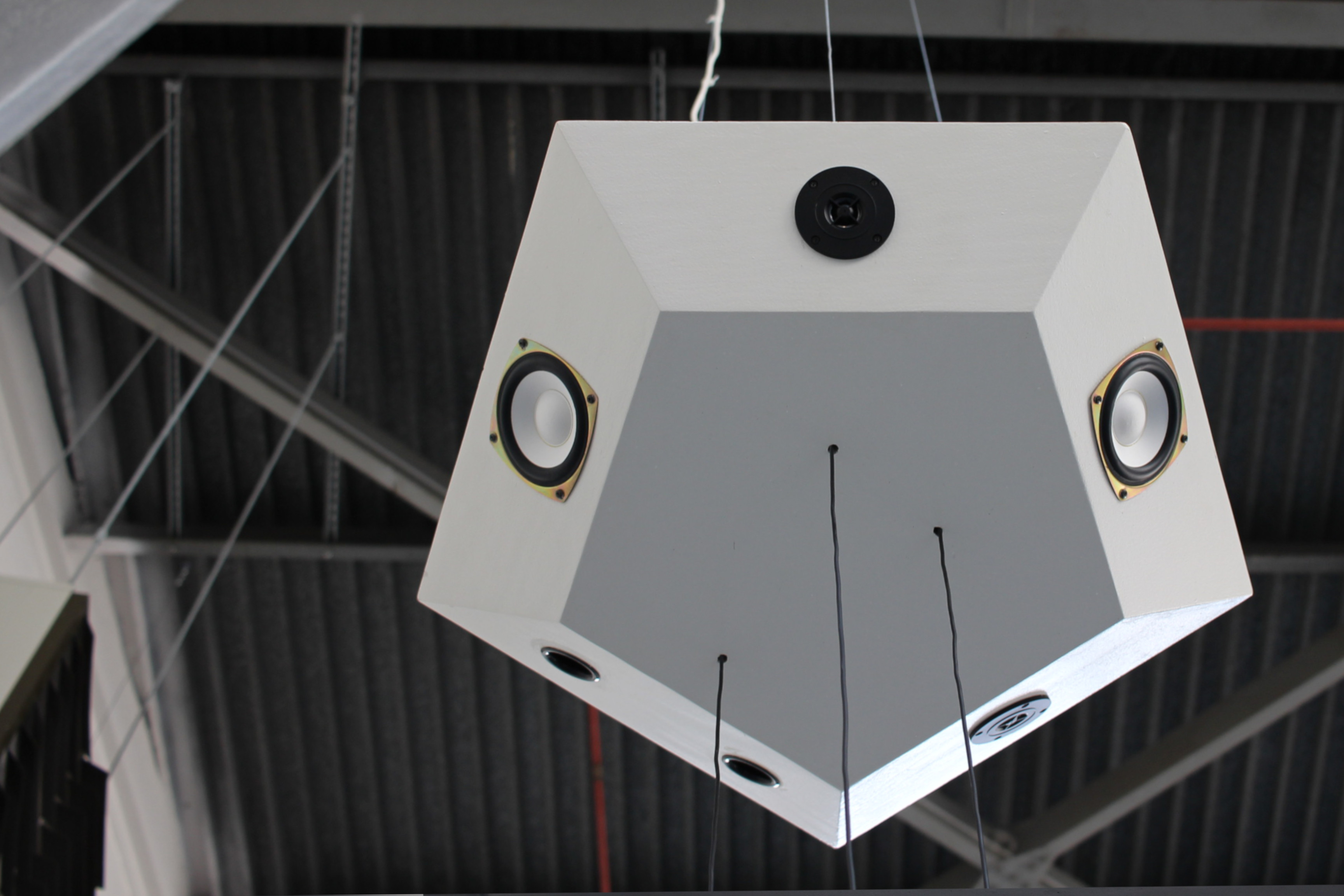
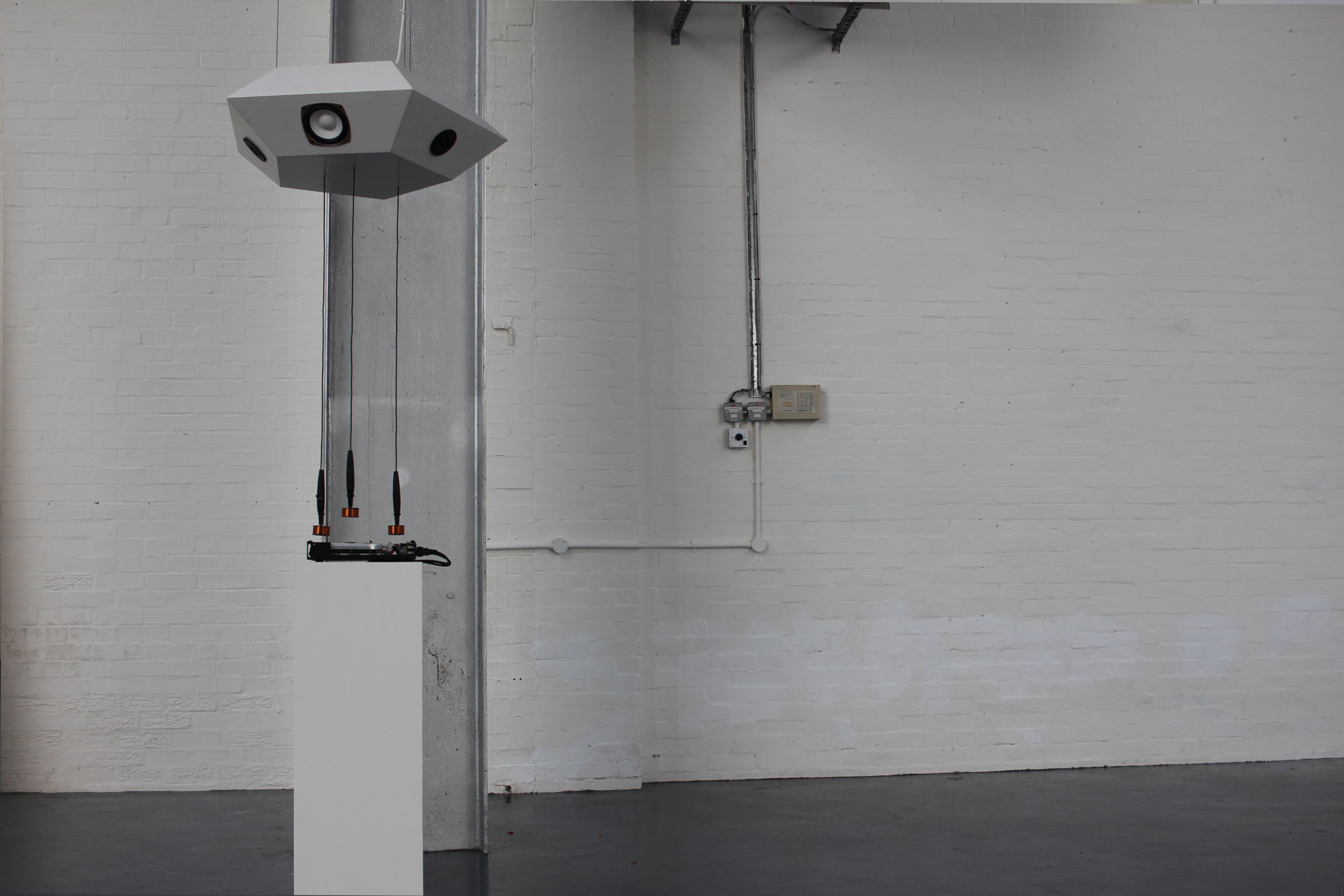
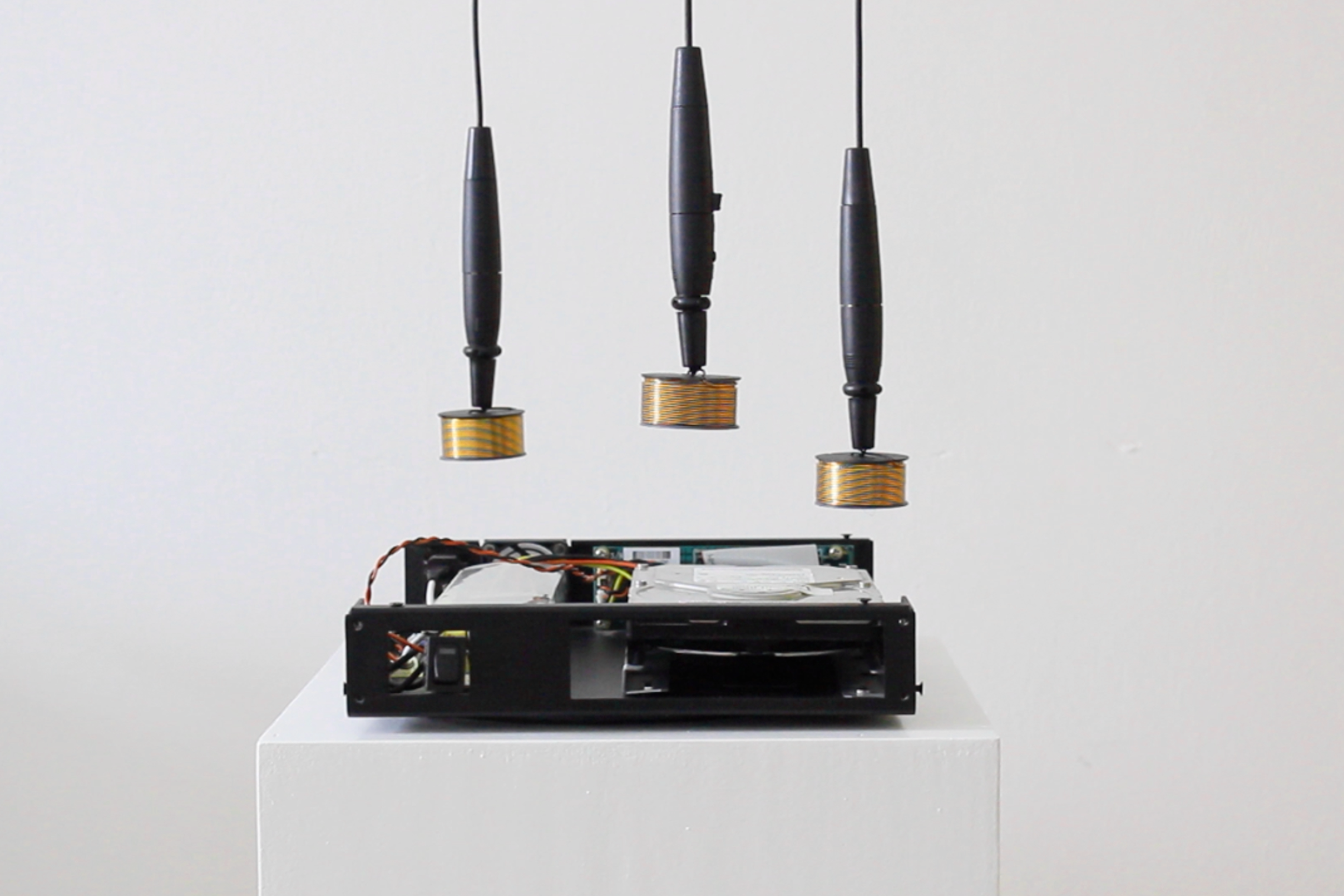
One technology of surveillance of electronic devices is the inductive recording of electromagnetic fields. The extent of such intrusions was documented in the Snowden leaks and again in the “CIA Hacking Tools” released by Wikileaks in March 2017. These invisible techniques of accessing private data can be experienced in the installation Surveillance Music as sound. The installation consists of four parts: Polygon, hard drive, pedestal and inductional coil microphones. The white smooth polygon is floating two meters above ground, attached to three thin metal strings. It features speakers on the sides and black cables hanging down from three openings. Connected to the end of the cables are inductional coil microphones. These move vertically in the electromagnetic field of the hard drive, controlled by a computer and motors hidden in the polygon. The microphones transform the electromagnetic field into our range of perception and makes it audible through the speakers.
In the process of making the electromagnetic field of the hard drive audible, the data on it is part of the sonic fingerprint and of the composition. The programmed movements of the inductional coil microphones form the music. The installation is looped.

Exhibitions:
2018 - Swinton Gallery, ln Sonora 10, Madrid (ES)
2017 - Scope Plus, Huddesfield (UK)
2016 - Galerie Wernert, Trossingen (D)
Arcana Swarm
by Kat VálasturDance | Sound Design | Composition | Live Mixing

“The sound, the objects, the diffuse light, the emotional states of suspension, the karst and exalted movements - all of this seems bizarre and puzzling, sometimes disturbing and frightening. And everything together results in the image of an obsessive-compulsive neurotic society - that seems to be its present diagnosis here. There is no well-tempered equilibrium, only states of constant excitement.
This is nothing new as a diagnosis, but it is accurate and perfectly staged by Kat Valastur in one of her most haunting pieces.”
- Frank Schmid, rbbKultur (21-11-2019) [Source]
Concept, script & choreography: Kat Válastur
Performance: Juan Pablo Cámara, Ixchel Mendoza Hernandez, Gaetano Montecasino, Ogbitse Omagbemi, Tamar Sonn, Sarah Stanley, Tiran Willemse
Light design: Martin Beeretz
Sound design: Peter Breitenbach
Set design: Leon Eixenberger
Costume: Kat Válastur
Dramaturgical advice: Einav Katan-Schmid, Maja Zimmermann Outside eye: Alexandra Balona / Yiannis Papachristos
Assistance choreography: Kévin Quinaou
Production management: HAU Artist Office / Sabine Seifert
Touring & distribution: HAU Artist Office / Nicole Schuchardt
Further Information ︎.
- Video, editing: Kat Válastur
- Music: Peter Breitenbach (Composition for ›Arcana Swarm‹)
- Images, documentary photography: Richard Drew, Sebastiao Salgado, Robert Frank
- Paintings, art works: Jan Van Eyk, Gian Lorenzo Bernini, Jacopo Pontormo, Théodore Géricault, Pieter Bruegel, intertwined with excerpts from the piece ›Arcana Swarm‹
Performances:
- Berlin, HAU Hebbel am Ufer
- Paris, Théâtre de la Cité International, within the programming of Théâtre de la Ville
- Kortrijk, Next Festival
- 06.12.2019